Back
Back
Ghost Tours of Savannah
Ghost Tours of Savannah
Spring 2025 | Prof. Mauricio Manhaes
Spring 2025 | Prof. Mauricio Manhaes
Spring 2025 | Prof. Mauricio Manhaes
Spring 2025 | Prof. Mauricio Manhaes
Service Designer, Analyst, Strategist, PM
Service Designer, Analyst, Strategist, PM
Service Designer, Analyst, Strategist, PM
Service Designer, Analyst, Strategist, PM
Service Designer, Analyst, Strategist, PM
Team : Pallavi Borkar, Chelsea Li, Ivy Ye, Raina Zhang
Team : Pallavi Borkar, Chelsea Li, Ivy Ye, Raina Zhang
Team : Pallavi Borkar, Chelsea Li, Ivy Ye, Raina Zhang
Team : Pallavi Borkar, Chelsea Li, Ivy Ye, Raina Zhang
Team : Pallavi Borkar, Chelsea Li, Ivy Ye, Raina Zhang
Skills
Skills
Skills
Design Research
Design Research
Design Research
Critical Thinking
Critical Thinking
Critical Thinking
Business Acumen
Business Acumen
Business Acumen
Methods
Methods
Methods
Ecosystem Maps
Ecosystem Maps
Ecosystem Maps
Stakeholder Maps
Stakeholder Maps
Stakeholder Maps
CJM
CJM
CJM
Service Blueprint
Service Blueprint
Service Blueprint
Co-creation Workshops
Co-creation Workshops
Co-creation Workshops
Overview
Overview
Overview
Overview
This project is a service design experiment focused on improving the guest experience for one of Savannah's most popular tourist attractions: its ghost tours. By conducting on-site research and using a unique AI-assisted workflow to analyze data, we identified key service gaps during the tour's transitional moments. We then designed and tested a series of low-cost, high-impact micro-interventions that significantly improved guest engagement and satisfaction.
This project is a service design experiment focused on improving the guest experience for one of Savannah's most popular tourist attractions: its ghost tours. By conducting on-site research and using a unique AI-assisted workflow to analyze data, we identified key service gaps during the tour's transitional moments. We then designed and tested a series of low-cost, high-impact micro-interventions that significantly improved guest engagement and satisfaction.
This project is a service design experiment focused on improving the guest experience for one of Savannah's most popular tourist attractions: its ghost tours. By conducting on-site research and using a unique AI-assisted workflow to analyze data, we identified key service gaps during the tour's transitional moments. We then designed and tested a series of low-cost, high-impact micro-interventions that significantly improved guest engagement and satisfaction.
Challenge
Challenge
Challenge
Challenge
Savannah's walking ghost tours fail to deliver an immersive experience, leading to guest fatigue and disengagement during the long, unstructured walks between stops. This "emotional drop-off" results in a poor overall experience and low satisfaction.
Savannah's walking ghost tours fail to deliver an immersive experience, leading to guest fatigue and disengagement during the long, unstructured walks between stops. This "emotional drop-off" results in a poor overall experience and low satisfaction.
Approach
Approach
Approach
Approach
We conducted a measurable service experiment, shadowing tours and interviewing guests to collect qualitative and quantitative data. We then used an innovative, AI-assisted workflow to analyze interview transcripts and online reviews, which allowed us to visualize the guest journey and pinpoint specific moments of disengagement.
We conducted a measurable service experiment, shadowing tours and interviewing guests to collect qualitative and quantitative data. We then used an innovative, AI-assisted workflow to analyze interview transcripts and online reviews, which allowed us to visualize the guest journey and pinpoint specific moments of disengagement.
Result
Result
Result
Result
The experiment was a clear success. By implementing a toolkit of low-cost "micro-interventions" for the tour guide like adding mini-stops and interactive games the average guest satisfaction score nearly doubled, increasing from 4/10 to 7.5/10.
The experiment was a clear success. By implementing a toolkit of low-cost "micro-interventions" for the tour guide like adding mini-stops and interactive games the average guest satisfaction score nearly doubled, increasing from 4/10 to 7.5/10.
The Challenge: The Failing "In-Between" Moments
The Challenge: The Failing "In-Between" Moments
The Challenge: The Failing "In-Between" Moments
While Savannah's ghost tourism is a $27.6 million industry, the on-the-ground experience often fails to deliver on its promise of immersive storytelling. Our initial research identified that the biggest problems weren't the ghost stories themselves, but everything happening between them.
While Savannah's ghost tourism is a $27.6 million industry, the on-the-ground experience often fails to deliver on its promise of immersive storytelling. Our initial research identified that the biggest problems weren't the ghost stories themselves, but everything happening between them.
Our on-site observations and data analysis revealed that the long, unstructured walks between haunted locations were causing a significant drop in guest engagement. Key issues included:
Our on-site observations and data analysis revealed that the long, unstructured walks between haunted locations were causing a significant drop in guest engagement. Key issues included:
Physical and Emotional Fatigue
Physical and Emotional Fatigue
Physical and Emotional Fatigue
Long walking transitions led to group dispersion and tiredness, especially for children and older guests
Long walking transitions led to group dispersion and tiredness, especially for children and older guests
Environmental Discomfort
Environmental Discomfort
Environmental Discomfort
Distractions like mosquitoes, street noise, and a lack of seating pulled guests out of the experience.
Missed Interaction Opportunities
Missed Interaction Opportunities
Missed Interaction Opportunities
Guides often walked ahead of the group during transitions, leading to a disconnected and less personal experience.
Guides often walked ahead of the group during transitions, leading to a disconnected and less personal experience.
Word frequency analysis of over 200 online reviews and tour transcripts confirmed this, showing that guests mentioned "Walking," "Guide," and "Time" more than almost anything else, proving that the logistics of the tour were just as important as the content.
Word frequency analysis of over 200 online reviews and tour transcripts confirmed this, showing that guests mentioned "Walking," "Guide," and "Time" more than almost anything else, proving that the logistics of the tour were just as important as the content.
The Approach: A Measurable Experiment
The Approach: A Measurable Experiment
To solve this, we designed a measurable service experiment focused specifically on the "Transitions Between Tour Stops." Our approach was to meticulously measure the existing service, analyze the data, and then introduce small changes to measure the difference.
To solve this, we designed a measurable service experiment focused specifically on the "Transitions Between Tour Stops." Our approach was to meticulously measure the existing service, analyze the data, and then introduce small changes to measure the difference.
Step 1: On-Site Data Collection
Step 1: On-Site Data Collection
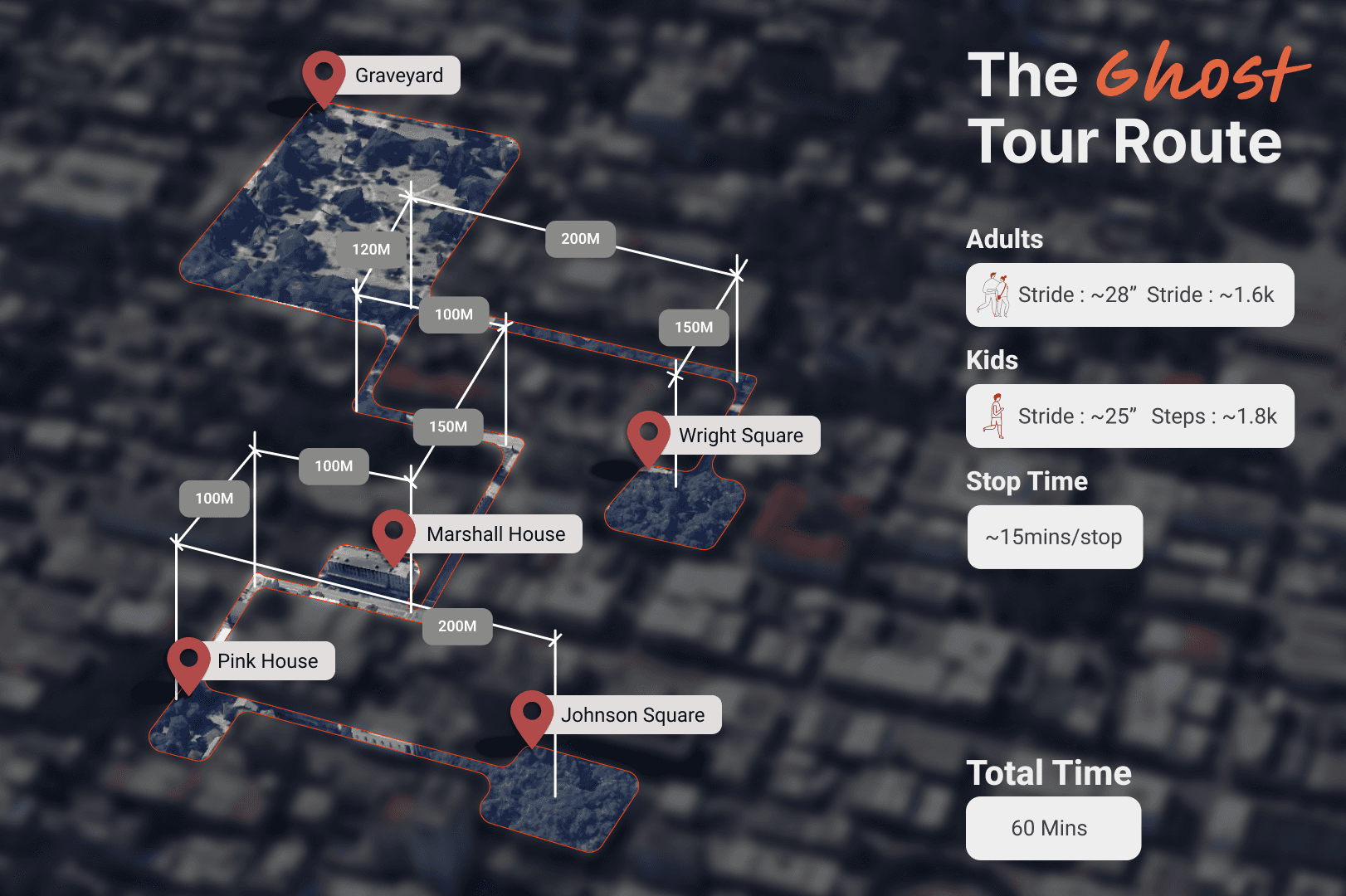
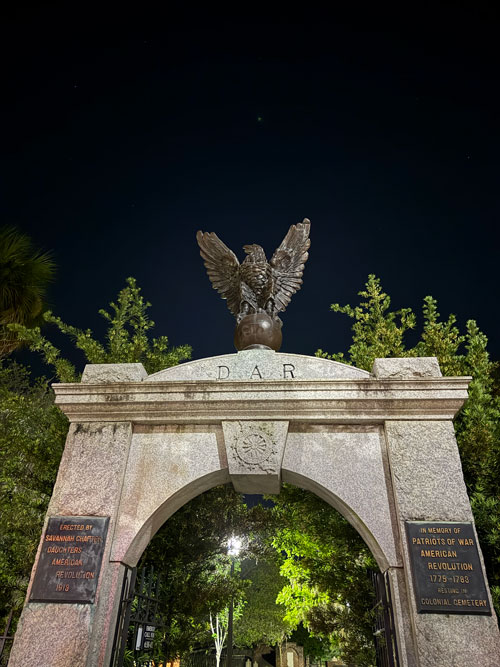
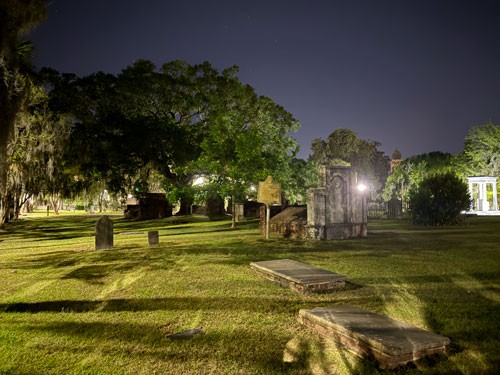
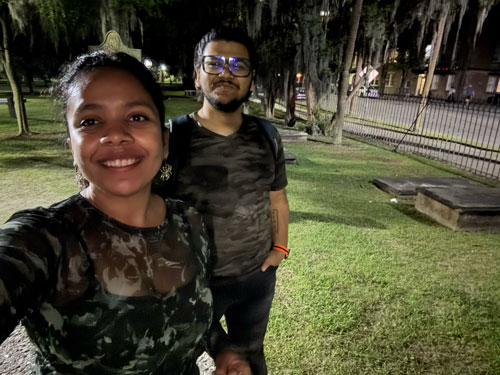
We visited multiple ghost tour sites in Savannah to capture real-world data tracking steps, measuring route durations, and noting crowd patterns. We also conducted quick interviews with participants and staff to understand expectations, emotions, and service gaps. These observations helped ground our research in the actual tour experience.
We visited multiple ghost tour sites in Savannah to capture real-world data tracking steps, measuring route durations, and noting crowd patterns. We also conducted quick interviews with participants and staff to understand expectations, emotions, and service gaps. These observations helped ground our research in the actual tour experience.
Step 2: A Unique AI-Assisted Workflow
Step 2: A Unique AI-Assisted Workflow
To process our data, we employed a GenAI-assisted workflow. This was a critical and innovative part of our methodology:
To process our data, we employed a GenAI-assisted workflow. This was a critical and innovative part of our methodology:
We used AI to transcribe and analyze the post-tour interviews.
The AI helped us extract behavioral patterns and generate word frequency and sentiment analysis from hundreds of online reviews and our own transcripts.
This allowed us to quickly process a massive amount of qualitative data and translate the insights into a clear, visual-ready format for our team and stakeholders.
Step 3: Synthesizing the Data
Step 3: Synthesizing the Data
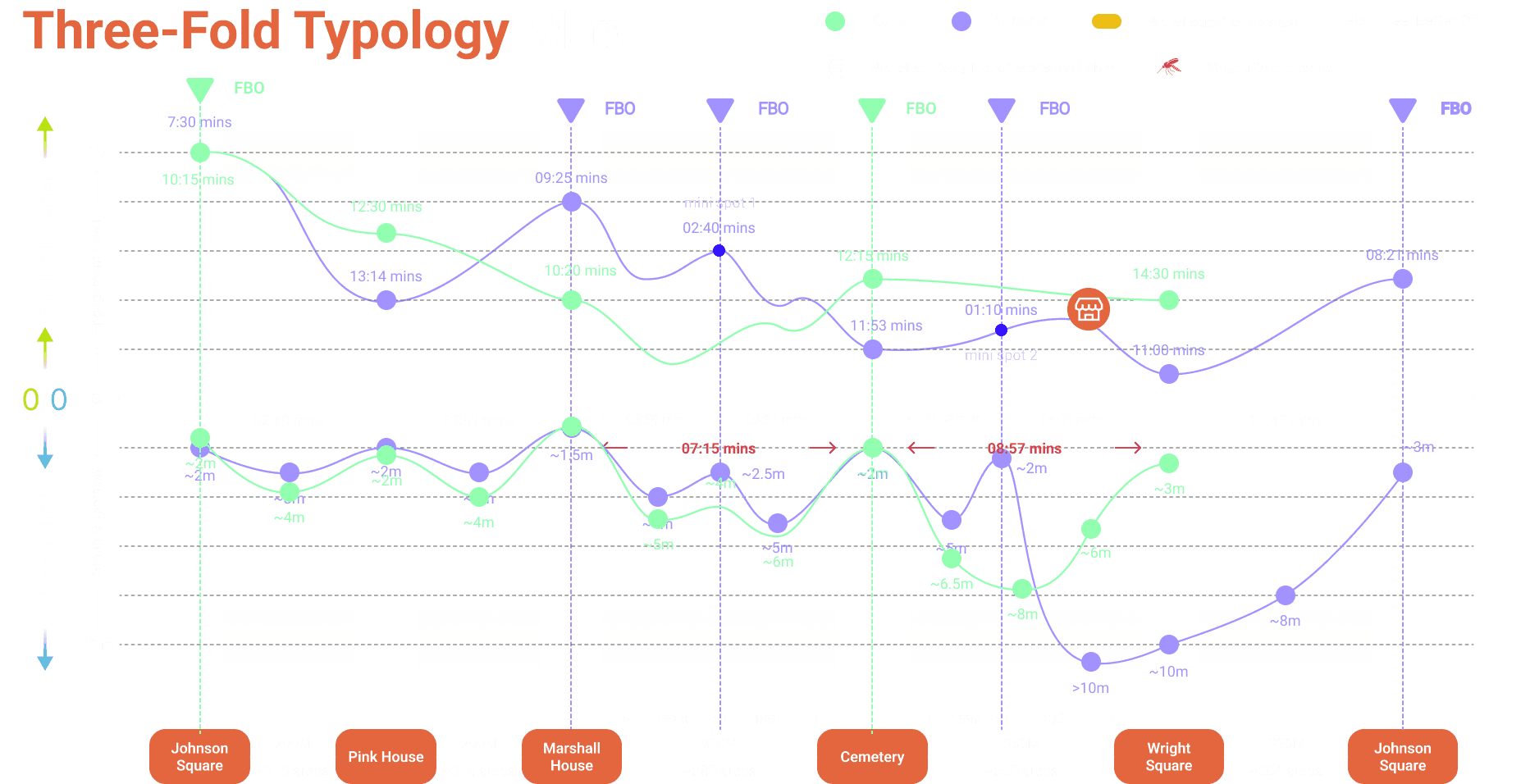
We synthesized all our findings into Three-Fold Typology Maps. These unique journey maps allowed us to visualize three layers of data simultaneously: the guests' Emotional Journey, the tour's Process Effort (like group dispersion), and key Operational Metrics (like time and distance).
We synthesized all our findings into Three-Fold Typology Maps. These unique journey maps allowed us to visualize three layers of data simultaneously: the guests' Emotional Journey, the tour's Process Effort (like group dispersion), and key Operational Metrics (like time and distance).
The Challenge: The Failing "In-Between" Moments
While Savannah's ghost tourism is a $27.6 million industry, the on-the-ground experience often fails to deliver on its promise of immersive storytelling. Our initial research identified that the biggest problems weren't the ghost stories themselves, but everything happening between them.
Our on-site observations and data analysis revealed that the long, unstructured walks between haunted locations were causing a significant drop in guest engagement. Key issues included:
Physical and Emotional Fatigue
Long walking transitions led to group dispersion and tiredness, especially for children and older guests
Environmental Discomfort
Distractions like mosquitoes, street noise, and a lack of seating pulled guests out of the experience.
Missed Interaction Opportunities
Guides often walked ahead of the group during transitions, leading to a disconnected and less personal experience.
Word frequency analysis of over 200 online reviews and tour transcripts confirmed this, showing that guests mentioned "Walking," "Guide," and "Time" more than almost anything else, proving that the logistics of the tour were just as important as the content.
The Approach: A Measurable Experiment
To solve this, we designed a measurable service experiment focused specifically on the "Transitions Between Tour Stops." Our approach was to meticulously measure the existing service, analyze the data, and then introduce small changes to measure the difference.
Step 1: On-Site Data Collection
We visited multiple ghost tour sites in Savannah to capture real-world data tracking steps, measuring route durations, and noting crowd patterns. We also conducted quick interviews with participants and staff to understand expectations, emotions, and service gaps. These observations helped ground our research in the actual tour experience.
Step 2: A Unique AI-Assisted Workflow
To process our data, we employed a GenAI-assisted workflow. This was a critical and innovative part of our methodology:
We used AI to transcribe and analyze the post-tour interviews.
The AI helped us extract behavioral patterns and generate word frequency and sentiment analysis from hundreds of online reviews and our own transcripts.
This allowed us to quickly process a massive amount of qualitative data and translate the insights into a clear, visual-ready format for our team and stakeholders.
Step 3: Synthesizing the Data
We synthesized all our findings into Three-Fold Typology Maps. These unique journey maps allowed us to visualize three layers of data simultaneously: the guests' Emotional Journey, the tour's Process Effort (like group dispersion), and key Operational Metrics (like time and distance).
The Challenge: The Failing "In-Between" Moments
While Savannah's ghost tourism is a $27.6 million industry, the on-the-ground experience often fails to deliver on its promise of immersive storytelling. Our initial research identified that the biggest problems weren't the ghost stories themselves, but everything happening between them.
Our on-site observations and data analysis revealed that the long, unstructured walks between haunted locations were causing a significant drop in guest engagement. Key issues included:
Physical and Emotional Fatigue
Long walking transitions led to group dispersion and tiredness, especially for children and older guests
Environmental Discomfort
Distractions like mosquitoes, street noise, and a lack of seating pulled guests out of the experience.
Missed Interaction Opportunities
Guides often walked ahead of the group during transitions, leading to a disconnected and less personal experience.
Word frequency analysis of over 200 online reviews and tour transcripts confirmed this, showing that guests mentioned "Walking," "Guide," and "Time" more than almost anything else, proving that the logistics of the tour were just as important as the content.
The Approach: A Measurable Experiment
To solve this, we designed a measurable service experiment focused specifically on the "Transitions Between Tour Stops." Our approach was to meticulously measure the existing service, analyze the data, and then introduce small changes to measure the difference.
Step 1: On-Site Data Collection
We visited multiple ghost tour sites in Savannah to capture real-world data tracking steps, measuring route durations, and noting crowd patterns. We also conducted quick interviews with participants and staff to understand expectations, emotions, and service gaps. These observations helped ground our research in the actual tour experience.
Step 2: A Unique AI-Assisted Workflow
To process our data, we employed a GenAI-assisted workflow. This was a critical and innovative part of our methodology:
We used AI to transcribe and analyze the post-tour interviews.
The AI helped us extract behavioral patterns and generate word frequency and sentiment analysis from hundreds of online reviews and our own transcripts.
This allowed us to quickly process a massive amount of qualitative data and translate the insights into a clear, visual-ready format for our team and stakeholders.
Step 3: Synthesizing the Data
We synthesized all our findings into Three-Fold Typology Maps. These unique journey maps allowed us to visualize three layers of data simultaneously: the guests' Emotional Journey, the tour's Process Effort (like group dispersion), and key Operational Metrics (like time and distance).
The Solution: A Toolkit of Micro-Interventions
The Solution: A Toolkit of Micro-Interventions
The Solution: A Toolkit of Micro-Interventions
The Solution: A Toolkit of Micro-Interventions
Our research showed that a complete overhaul of the tour wasn't necessary. Instead, we developed a toolkit of small, low-cost "micro-interventions" that guides could use to manage the energy and engagement of the group during transitions. Key solutions included:
Our research showed that a complete overhaul of the tour wasn't necessary. Instead, we developed a toolkit of small, low-cost "micro-interventions" that guides could use to manage the energy and engagement of the group during transitions. Key solutions included:
Our research showed that a complete overhaul of the tour wasn't necessary. Instead, we developed a toolkit of small, low-cost "micro-interventions" that guides could use to manage the energy and engagement of the group during transitions. Key solutions included:
The Mini Stop
The Mini Stop
The Mini Stop
The Mini Stop
During long walks (over 200m), the guide pauses for a brief, 30-second story to let guests catch up and re-engage.
During long walks (over 200m), the guide pauses for a brief, 30-second story to let guests catch up and re-engage.
Narrative Pacing
Narrative Pacing
Narrative Pacing
Narrative Pacing
Telling the most compelling story (the "Spanish Moss" legend) at the beginning of the tour to hook the audience, rather than at the end when they are already tired.
Telling the most compelling story (the "Spanish Moss" legend) at the beginning of the tour to hook the audience, rather than at the end when they are already tired.
The Walk-along
The Walk-along
The Walk-along
The Walk-along
At street crossings, the guide walks with the group instead of ahead, maintaining group cohesion and a personal connection.
At street crossings, the guide walks with the group instead of ahead, maintaining group cohesion and a personal connection.
Interactive Games
Interactive Games
Interactive Games
Interactive Games
Simple games like "Spot the Moss!" were introduced to keep kids (a primary audience) engaged during walks.
Simple games like "Spot the Moss!" were introduced to keep kids (a primary audience) engaged during walks.
The Impact : Doubling Guest Satisfaction
The Impact : Doubling Guest Satisfaction
The Impact : Doubling Guest Satisfaction
The Impact : Doubling Guest Satisfaction
Our experiment proved that these small interventions have a massive impact. We measured two tours: one that did not use our interventions (Donald's tour) and one that did (Katie's tour). The data from our Typology Maps showed a clear difference.
The tour that used our micro-interventions saw:
Our experiment proved that these small interventions have a massive impact. We measured two tours: one that did not use our interventions (Donald's tour) and one that did (Katie's tour). The data from our Typology Maps showed a clear difference.
The tour that used our micro-interventions saw:
Our experiment proved that these small interventions have a massive impact. We measured two tours: one that did not use our interventions (Donald's tour) and one that did (Katie's tour). The data from our Typology Maps showed a clear difference.
The tour that used our micro-interventions saw:
Our experiment proved that these small interventions have a massive impact. We measured two tours: one that did not use our interventions (Donald's tour) and one that did (Katie's tour). The data from our Typology Maps showed a clear difference.
The tour that used our micro-interventions saw:
A higher and more stable emotional engagement level throughout the 90-minute experience.
A higher and more stable emotional engagement level throughout the 90-minute experience.
Less group dispersion, with guests staying more cohesive and focused.
Less group dispersion, with guests staying more cohesive and focused.
The average Customer Satisfaction Score nearly doubled, jumping from 4/10 on the control tour to 7.5/10 on the test tour.
The average Customer Satisfaction Score nearly doubled, jumping from 4/10 on the control tour to 7.5/10 on the test tour.
Learnings & Reflection
Learnings & Reflection
Learnings & Reflection
Learnings & Reflection
This project was a powerful lesson in the importance of the "in-between" moments in a service experience. Our biggest takeaway was that what happens between the main events is just as crucial as the events themselves. We also learned that you don't always need a large-scale, expensive redesign to make a difference. Small, thoughtful, data-driven interventions can lead to a significant and measurable improvement in the user experience.
This project was a powerful lesson in the importance of the "in-between" moments in a service experience. Our biggest takeaway was that what happens between the main events is just as crucial as the events themselves. We also learned that you don't always need a large-scale, expensive redesign to make a difference. Small, thoughtful, data-driven interventions can lead to a significant and measurable improvement in the user experience.
This project was a powerful lesson in the importance of the "in-between" moments in a service experience. Our biggest takeaway was that what happens between the main events is just as crucial as the events themselves. We also learned that you don't always need a large-scale, expensive redesign to make a difference. Small, thoughtful, data-driven interventions can lead to a significant and measurable improvement in the user experience.
Back to top
Back to top
Back to top
Explore More Projects
Explore More Projects

Spoiler : I can make your team look good
Spoiler : I can make your team look good